
CX 2026: From Personalization to Precision The Five Shifts Redefining Experience in the GCC
The Experience Recalibration
Customer experience has reached an inflection point. Over the past decade, organizations invested heavily in mapping journeys, automating feedback loops, and deploying omnichannel platforms. These efforts raised the baseline of CX maturity but also exposed diminishing returns. Most companies can now deliver a “good” experience. The real question is: what defines advantage when everyone can?
The next frontier is precision experience where every interaction is not only personalized but contextually intelligent, ethically designed, and strategically measurable. Precision fuses analytics, empathy, and automation into one adaptive system capable of anticipating rather than reacting.
In the GCC, this evolution is amplified by national agendas such as Saudi Arabia’s Vision 2030 and the UAE’s Digital Government Strategy. These programs accelerate not just digitization but experience governance embedding CX into public accountability frameworks. As a result, the region is moving faster than most toward precision-led design.
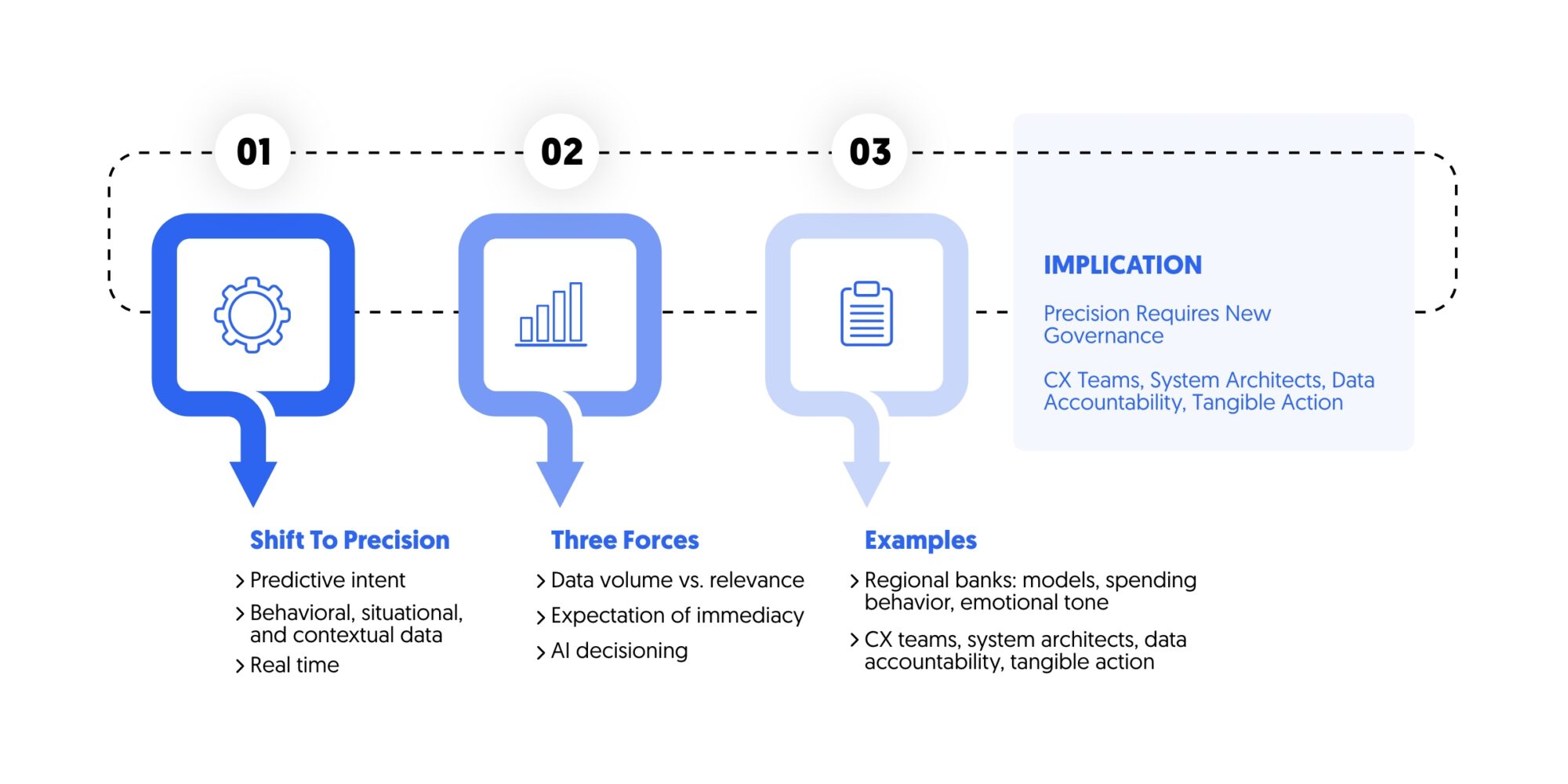
1. From Personalization to Precision
Traditional personalization relies on historical behavior. Precision, by contrast, operates on predictive intent.
It requires organizations to integrate behavioral, situational, and contextual data in real time to understand why a customer acts, not just what they do.
Three forces make this shift unavoidable:
- Data Volume vs. Relevance: Organizations collect more data than they can use. Precision demands prioritization i.e. deciding which signals matter at each moment.
- Expectation of Immediacy: Customers no longer separate digital from physical. A predictive insight that takes days to operationalize is obsolete.
- AI Decisioning: Generative and adaptive AI can now detect sentiment, predict churn, and simulate next actions with greater accuracy than human analysts.
For example, regional banks are already piloting models that adjust product recommendations based on spending behavior and emotional tone detected through digital interactions. In public services, pre-emptive eligibility checks and real-time guidance are turning reactive bureaucracies into proactive systems.
Implication for leaders: Precision requires new governance. CX teams must evolve from storytellers to system architects building cross-functional data accountability to ensure predictions translate into tangible action.
2. The Rise of Ethical and Sustainable Experience (CX + ESG)
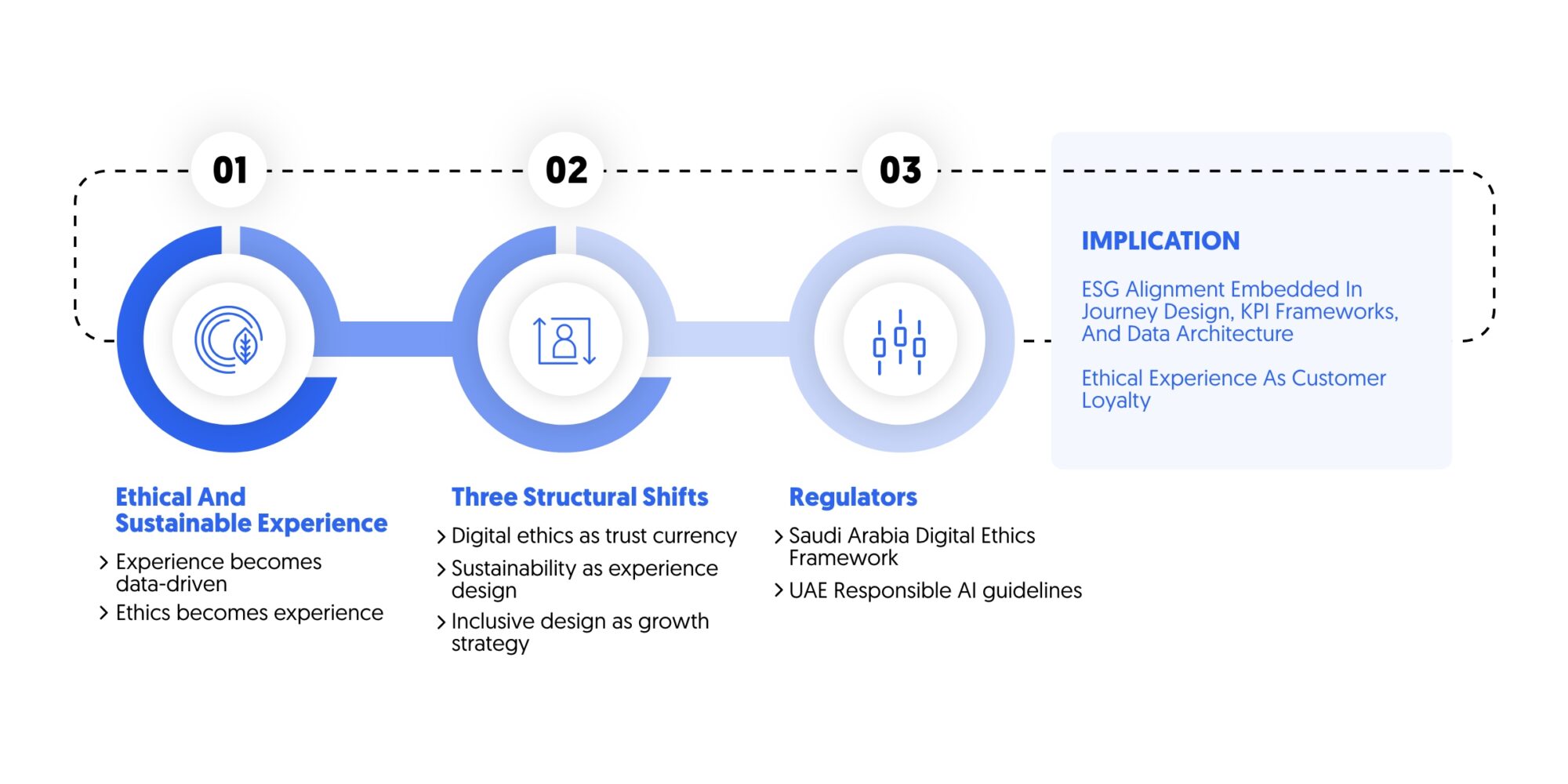
As experience becomes data-driven, ethics becomes experience.
Customers now perceive ethical lapses biased algorithms, opaque consent practices, environmental neglect as direct service failures.
The convergence of CX and ESG reflects three structural shifts:
- Digital ethics as trust currency. In a hyperconnected market, trust is a measurable asset. ESG-aligned organizations see higher retention and advocacy because customers believe their data and values are respected.
- Sustainability as experience design. Reducing friction now includes minimizing environmental impact: think paperless services, optimized logistics, or low-carbon digital infrastructure.
- Inclusive design as growth strategy. Accessibility for all demographics, including people with disabilities or limited digital literacy, is becoming a competitive differentiator.
GCC regulators are moving in this direction. Saudi Arabia’s Digital Ethics Framework and the UAE’s Responsible AI guidelines are already shaping how organizations operationalize CX.
Implication for leaders: ESG alignment should not sit in annual reports. It must be embedded in journey design, KPI frameworks, and data architecture. Ethical experience is the next source of customer loyalty.
3. Unified Experience Ecosystems
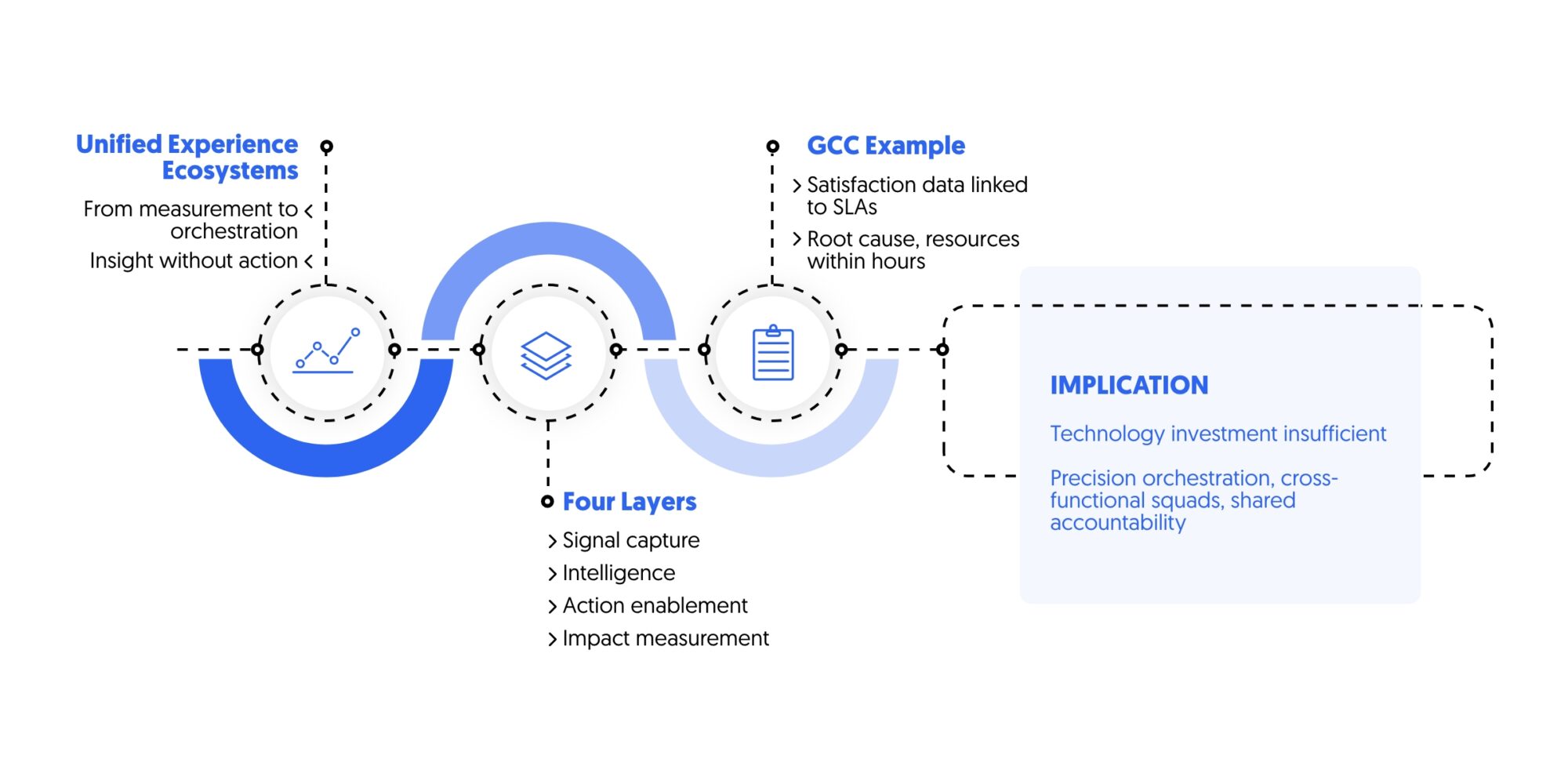
In 2025, most organizations still manage CX through fragmented tools: one for surveys, one for analytics, one for CRM. The result is latency: insight without action.
2026 marks the pivot from measurement to orchestration.
Unified experience ecosystems integrate four layers:
- Signal Capture: Continuous listening through digital, voice, and operational data.
- Intelligence: AI-driven synthesis that identifies systemic friction, not isolated complaints.
- Action Enablement: Automation linking insights to operational triggers: refunds, alerts, workflow adjustments.
- Impact Measurement: Closed-loop dashboards tying experience metrics to financial or efficiency outcomes.
This architecture is taking hold in the GCC, where government entities now link satisfaction data to SLAs in real time. A municipality can identify the root cause of citizen dissatisfaction and redeploy resources within hours.
Implication for leaders: Technology investment alone is insufficient. Precision orchestration demands new operating models: cross-functional squads where marketing, operations, and IT share accountability for outcomes.
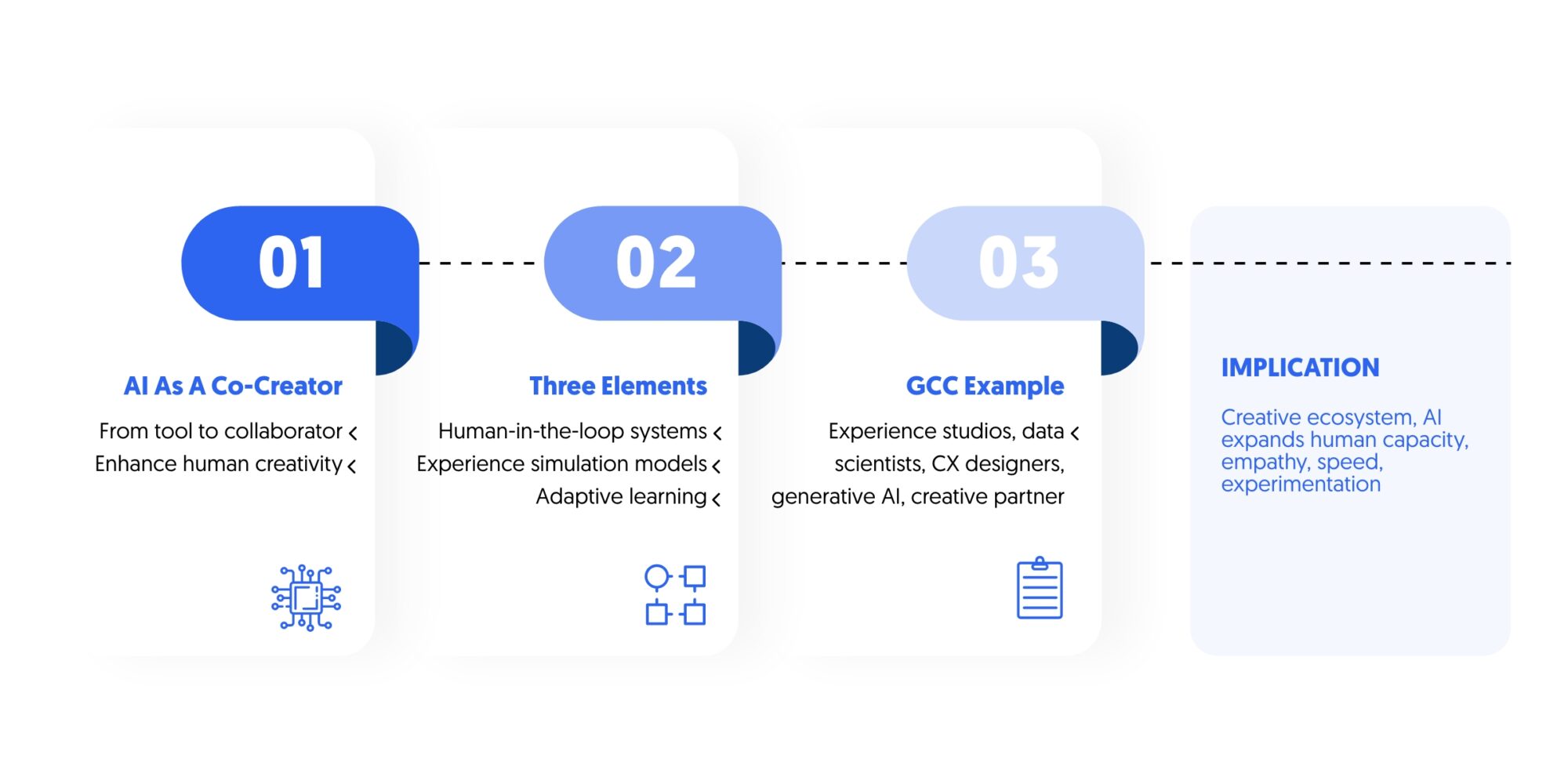
4. AI as a Co-Creator
Artificial intelligence is shifting from tool to collaborator.
Generative AI now participates in service design, content creation, and empathy modeling using emotion detection and language nuance to enhance human creativity.
Yet the real transformation lies in how organizations govern this collaboration.
- Human-in-the-loop systems ensure every AI-generated recommendation is reviewed for tone, fairness, and contextual accuracy.
- Experience simulation models allow leaders to test journey outcomes before launch reducing risk and bias.
- Adaptive learning feeds each customer interaction back into the model, ensuring the experience evolves continuously.
GCC organizations are experimenting with “experience studios,” where data scientists and CX designers co-develop predictive journeys using generative AI as a creative partner.
Implication for leaders: The future CX capability is no longer a chatbot. It’s a creative ecosystem where AI expands human capacity for empathy, speed, and experimentation.
5. Human Experience as the True Differentiator
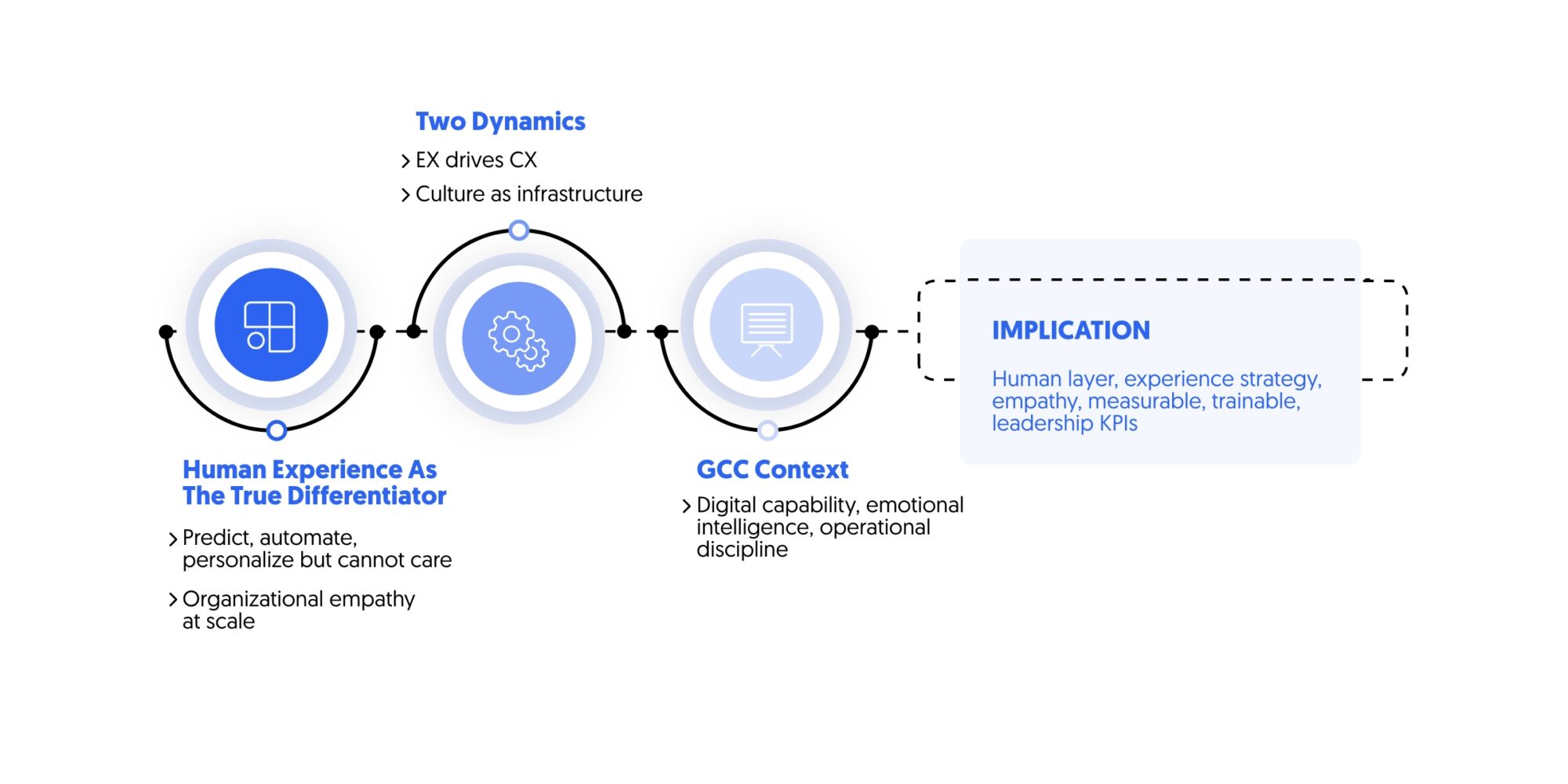
Technology can predict, automate, and personalize but it cannot care.
The next CX advantage lies in organizational empathy at scale: the ability to design systems that respond with human understanding, not scripted efficiency.
Two dynamics define this shift:
- EX drives CX. Every point of friction for employees eventually becomes visible to customers. Employee enablement, empowerment, and purpose alignment are now measurable predictors of customer satisfaction.
- Culture as infrastructure. Precision systems fail without a culture of accountability and curiosity. Organizations that reward learning and experimentation outperform those focused solely on compliance.
For GCC organizations, this is both challenge and opportunity. Transformation programs have built digital capability; the next phase is cultivating emotional intelligence as an operational discipline.
Implication for leaders: The human layer must evolve from service delivery to experience strategy ensuring empathy becomes a measurable, trainable skill embedded in leadership KPIs.
The GCC Advantage
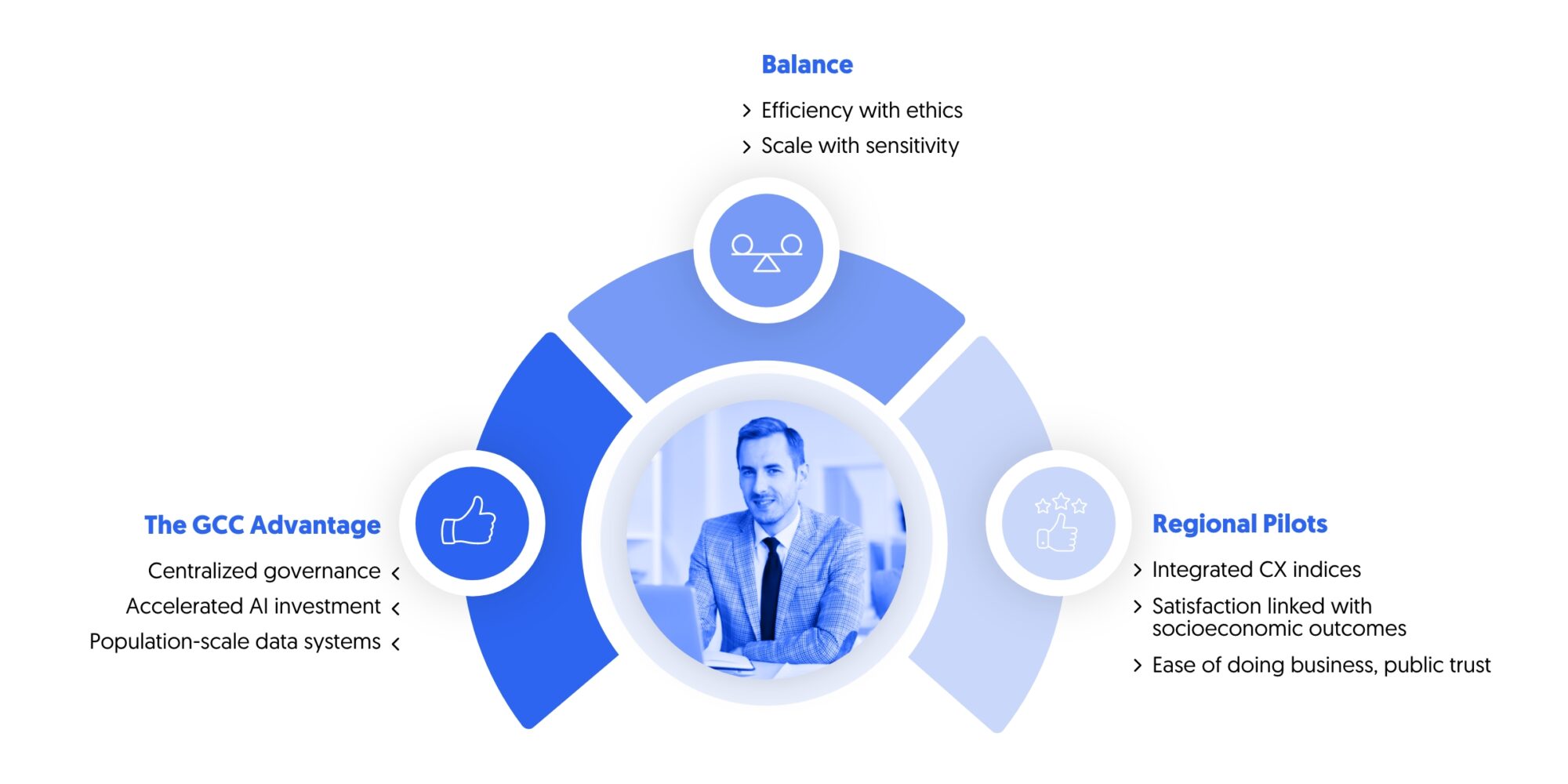
The GCC’s structural advantages- centralized governance, accelerated AI investment, and population-scale data systems- create a fertile environment for precision CX. But these advantages come with responsibility: designing experiences that balance efficiency with ethics, and scale with sensitivity.
Countries in the region are already piloting integrated CX indices that link satisfaction with socioeconomic outcomes, such as ease of doing business or public trust. This systemic approach transforms CX from a customer service discipline into an economic performance lever.
The Precision Era of CX
The evolution of customer experience mirrors the evolution of strategy itself: from static planning to adaptive intelligence. Precision represents this maturity where organizations orchestrate data, technology, and humanity to anticipate what matters next.
The defining question for 2026 is not how to make experiences memorable, but how to make them meaningful and measurable at once.
The organizations that succeed will be those that design experiences with intention, govern them with integrity, and deliver them with empathy.